Many car owners want to upgrade their headlights but often don’t know where to start. Searching online usually leads to scattered, conflicting advice that makes the process even more confusing. That’s why I decided to write this Ultimate Guide to Car Headlight Upgrade, based on years of professional experience and real installation cases. My goal is to gather everything you need to know in one place and help you avoid common mistakes.
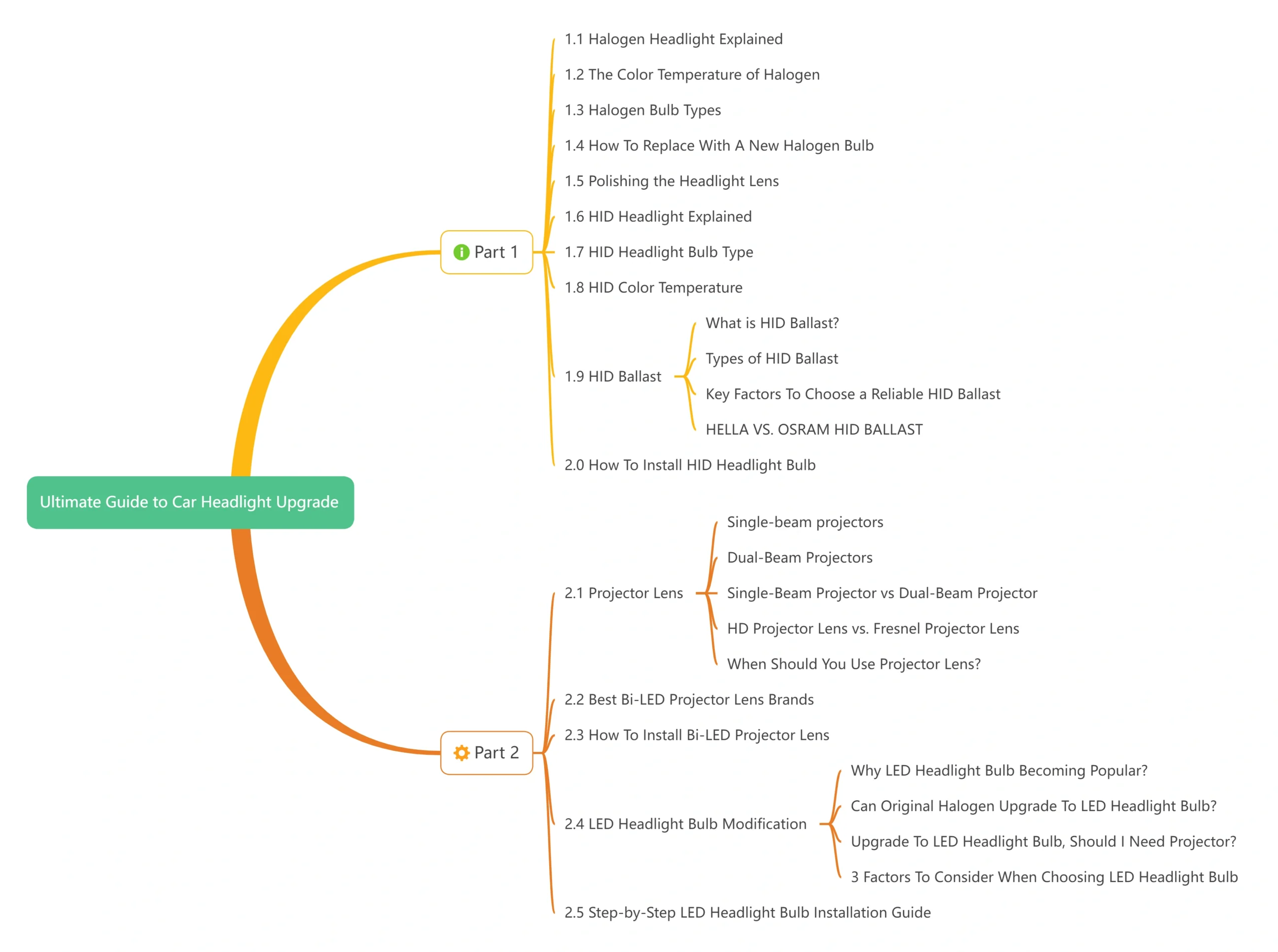
This blog will be divided into three parts: if you’re replacing halogen with halogen or HID with HID, read Part 1; if you’re upgrading halogen to LED bulbs or projector lenses, read Part 2.
1.1 Halogen Headlight Explained
This is the lighting technology that has accompanied us for so many years, and even today, halogen headlights are still widely used. A single halogen bulb only produces about 1,000 – 1200 lumens, with a luminous efficiency of 18- 20 lumens per watt, quite low by modern standards.
When paired with a reflector headlight, only about 40% of the light is actually utilized. That’s right, you’re only getting around 400 lumens of usable light.
Why is so much light wasted? It’s because the reflector assembly is designed with blackout areas or shading surfaces to control the beam pattern and prevent glare. These surfaces intentionally block or absorb light in certain directions, and on top of that, headlights on both sides of the car must be symmetrical, even though the light pattern is naturally opposite.
As a result, a large portion of the bulb’s light is either blocked or scattered, leaving only a small fraction effectively illuminating the road.
1.2 The Color Temperature of Halogen
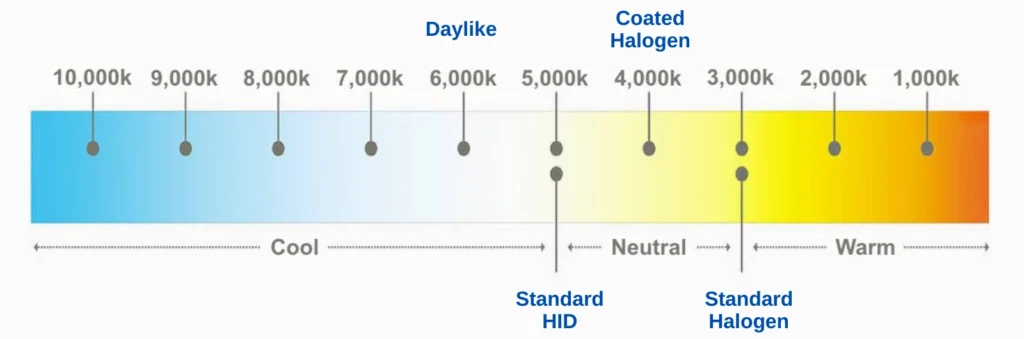
Halogen bulbs have a standard color temperature of 3200K, which is commonly called “candlelight.” This color temperature actually performs best in rain and fog.
However, 3200K is a bit on the yellow side. The warm yellow tone gives a cozy, comforting feeling, making it perfect for places like bedrooms or living rooms in winter.
In reality, there are many other color temperatures available on the market. Bulbs above or below 3200K usually achieve this by adding a coating to the glass, which changes the color temperature. This technology is quite mature, though it may slightly reduce the bulb’s lifespan.
📌 Read More: 4300K VS. 5800K VS. 6500K Faro LED, ¿Cuál es mejor para la conducción nocturna?
1.3 Halogen Bulb Types
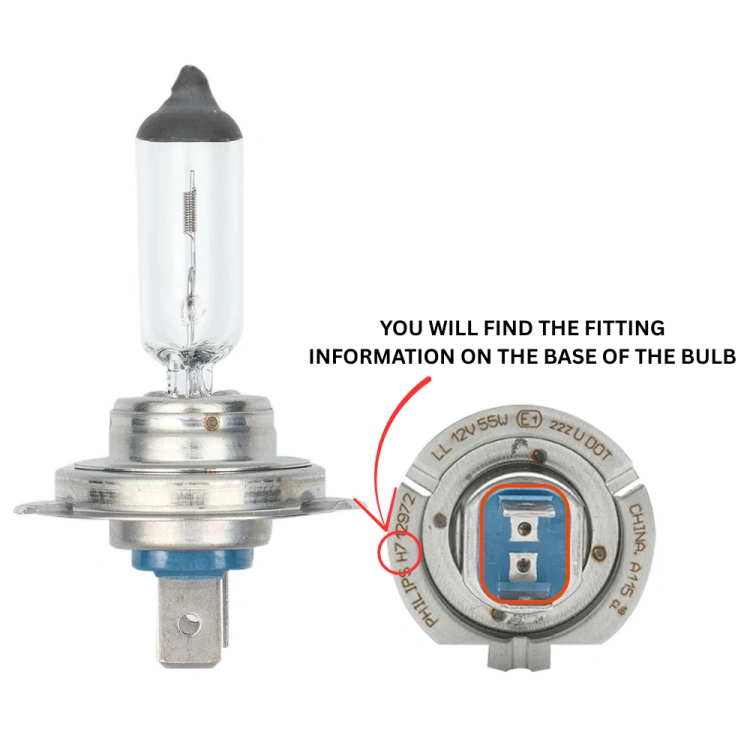
The diagram above already includes most of the halogen headlight bulbs. The specifications and packaging of these bulbs follow worldwide standard sizes, not any single manufacturer’s standard. This means that if your original car bulb is an Osram H1, you can replace it with a Philips H1 bulb, as long as the wattage is the same.
The packaging and design of the bulb determine the filament length and focal point for all manufacturers. If these are not correct, it will cause poor focus or beam distortion. As for performance, that depends on the quality of each manufacturer.
If the original bulb is a 55W H4, and you install a 100W H4 of the same design and packaging, you may face the following problems:
- Headlight wiring will age faster.
- The bulb’s connector at the base may melt, causing a short circuit.
- The headlight reflector may deform, or the reflective coating may peel off.
Some people have tried solutions like replacing the connector with a ceramic base and adding a headlight booster to draw power directly from the battery. However, this still cannot prevent problem #3, such as reflector deformation, reflective coating peeling, or the headlight lens yellowing. Halogen bulbs generate light through heat, so increasing from 55W to 100W produces significantly more heat. If your headlights are inexpensive, it might be worth a try, but most who have upgraded the wattage say the results are mediocre.
Look at the chart below—it clearly shows which bulb to choose. Besides focusing on color temperature, pay attention to the brightness as well.
📌 Read More: Guía definitiva de tipos de portalámparas para faros
PHILIPS VS OSRAM HALOGEN PRODUCTS COMPARED
|
Marca |
Modelo |
Luminosidad |
Color |
H1 |
H3 |
H4 |
H7 |
H8 |
H11 |
9005 |
9006 |
9012 |
Garantía |
|
Philips |
RacingVislon GT200 |
+200% |
3500K |
|
|
√ |
√ |
|
|
|
|
|
1 año |
|
X-tremeVIston Pro150 |
+150% |
3400K |
√ |
|
√ |
√ |
|
√ |
√ |
√ |
√ |
||
|
VistonPlus |
+60% |
3250K |
√ |
|
√ |
√ |
|
|
|
|
|
||
|
WhiteVIsion ultra |
|
4200K |
√ |
√ |
√ |
√ |
√ |
√ |
√ |
√ |
√ |
||
|
LongLife EcoVIston |
|
3100K |
√ |
√ |
√ |
√ |
|
√ |
|
|
√ |
||
|
Vision |
+30% |
3200K |
√ |
√ |
√ |
√ |
|
√ |
√ |
√ |
|
||
|
OSRAM |
OSRAM NIGHT BREAKER 220 |
+220% |
3700K |
|
|
√ |
√ |
|
√ |
|
|
|
1-4 year(s) |
|
OSRAM NIGHT BREAKER® LASER |
150% |
3900K |
√ |
√ |
√ |
√ |
√ |
√ |
√ |
√ |
|
||
|
OSRAM NIGHT BREAKER® SILVER |
100% |
3200K |
√ |
|
√ |
√ |
|
√ |
|
|
|
||
|
OSRAM COOL BLUE® INTENSE (NEXT GEN) |
100% |
5000K |
√ |
|
√ |
√ |
√ |
√ |
√ |
√ |
√ |
||
|
OSRAM ULTRA LIFE |
60% |
3200K |
√ |
|
√ |
√ |
|
√ |
|
|
|
||
|
OSRAM Original LINE 12V |
|
3200K |
√ |
√ |
√ |
√ |
√ |
√ |
√ |
√ |
√ |
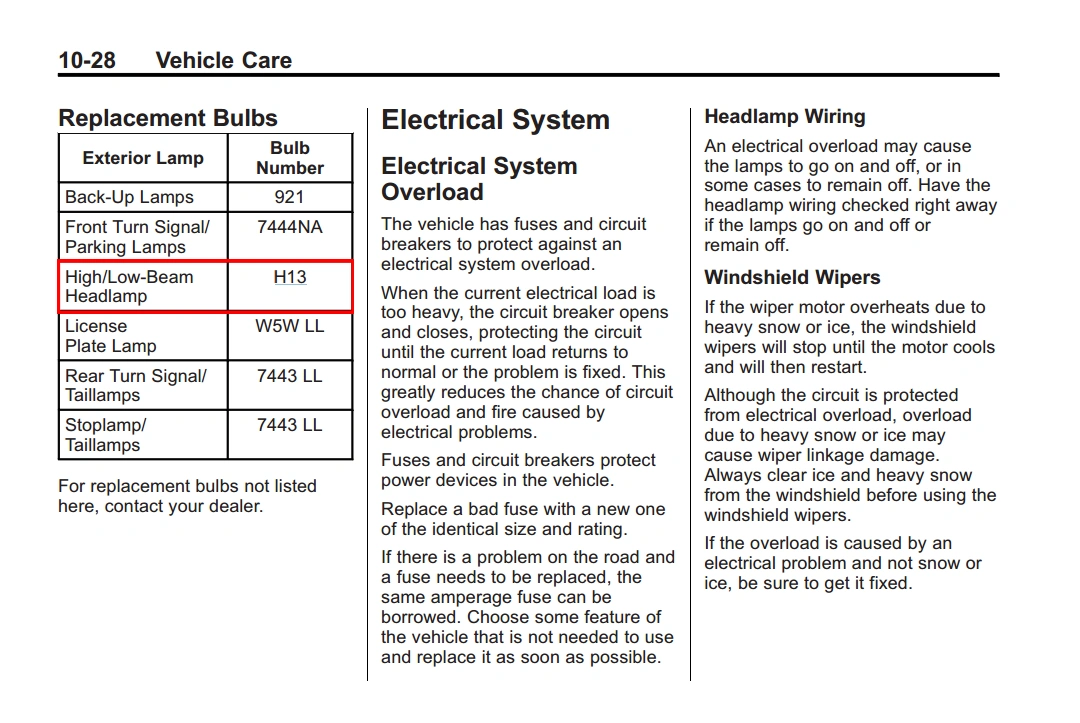
Let me repeat this clearly: as long as the bulb type is H1, the size and shape are the same for every brand. The only differences are color temperature and brightness. So any H1 bulb will fit into an H1 headlight.
A halogen bulb usually lasts De 500 a 1.000 horas. Even if the bulb doesn’t burn out, its brightness will drop a lot after around 500 hours—sometimes down to 30% or less. Normally, after one year the brightness is about 50%, and after two years, you should consider replacing the bulbs as a pair.
As for color temperature, Philips and Osram offer many options, as shown in the chart above. There are also many other brands, but we won’t list them all here.
Some people replace their bulbs but still feel the headlights are not as bright as when the car was new. This often means the headlight reflector has aged, so it doesn’t reflect light as well anymore. Another possible reason is that the bulb you installed is not genuine, it might be a fake product.
1.4 How To Replace With A New Halogen Bulb
[1] Identify your headlight bulb model
Before you replace your halogen bulb, you need to confirm the correct bulb model (H1, H4, H7, 9005, etc.). There are several simple ways to check this:
- Check your owner’s manual
- Look at the bulb holder or backside of your headlight
- If you want a fast and accurate way, enter your car’s year, brand, and model into a bulb finder tool such as Philips Bulb Finder, Buscador de bombillas Sylvania.
[2] Buy a new halogen bulb
- Once you know the bulb type, purchase a replacement from a trusted brand or supplier.
- Make sure the wattage is the same as your original bulb (for example, don’t replace 55W with 100W).
[3] Install the new halogen bulb
- Open the hood and locate the headlight area where the burnt-out bulb is installed.
- Different car models have different ways to remove the bulb, some headlights use a spring clip to hold the bulb in place.
- Insert the new bulb into the headlight housing, making sure it sits firmly and correctly in the socket.
- Finally, turn on your headlights to check that the new bulb is working properly.
1.5 Polishing the Headlight Lens
After a few years of use, the outer surface of a car’s headlight lens will naturally age. It may become cloudy, hazy, or show scratches. The following method can help restore the outside of the headlight lens:
- Protect surrounding paint: Use masking tape around the headlight to prevent scratches.
- Sand the headlight: For rough surfaces: start with 1200-grit wet sandpaper, then 2000-grit for finer polishing. For smoother surfaces: start directly with 2000-grit.
- Keep it wet: Always add water while sanding for a smooth, clean finish.
- Optional finishing: Apply a headlight restoration coating for an even better result.
1.6 HID Headlight Explained
About three years ago, HID (xenon) headlights became mainstream. They are popular not only because of their sleek design, but also because you can add Devil Eyes or Angel Eyes, giving the headlights a brighter, more striking, and personalized appearance. Their light efficiency is also quite good.
Most importantly, HID headlights produce a sharp low-beam cutoff line, with a very clear distinction between light and dark areas. When the low beams are on, they do not dazzle oncoming drivers, which greatly improves driving safety and confidence.
In terms of light efficiency, dual-beam HID (xenon) headlights are not as high as manufacturers often claim. While they advertise around 80% efficiency, a more realistic number would be about 60%, and that’s under high-beam conditions. When using low beams, part of the light is blocked, and the effective efficiency rarely exceeds 40%.
Even the front half of the projector lens only transmits up to 90% of the light, and there is significant light leakage between the reflector bowl and the lens. If you add decorative covers, much of the light is blocked inside and rarely contributes to effective illumination.
Additionally, the lens surface is treated with a frosted or Fresnel pattern. These light-diffusing treatments inevitably cause some light loss. But with 3,200 lumens × 60% = 1,920 lumens, that’s roughly 5 times the effective output of a halogen headlight’s 400 lumens.
If you’re considering upgrading to HID lights, please keep reading.
1.7 HID Headlight Bulb Type
Here are the most commonly used HID headlight bulb type, we also can call them D series headlight bulb. D series HID bulbs can be classified as D1S, D1R, D2S, D2R etc. What do these numbers and letters represent?
- D = Discharge (HID) bulb
- Odd numbers (1, 3) = With built-in igniter
- Even numbers (2, 4) = No built-in igniter, require a separate external igniter
- 1 & 2 = Contain mercury (older design)
- 3 & 4 = Mercury-free (eco-friendly design)
- S = For projector lens use
- R = For reflector bowl use
For example: D1S = Bombilla HID con cebador incorporado, contenido de mercurio, diseñada para lentes de proyector.
📌 Read More: ¿Cómo identificar fácilmente las bombillas de xenón HID D1 D2 D3 D4?
Even though D1S, D2S, D3S, and D4S may look similar, they are four completely different types of bulbs. They differ in mounting notches and operating voltages:
- D1S and D2S: Contain mercury, 85V design.
- D3S and D4S: Mercury-free, 45V design.
The mercury-free design was first proposed in Japan and later widely adopted in Europe. While D1S and D2S are slightly brighter and start faster, the trend toward environmentally friendly bulbs is unstoppable.
D1S and D2S may eventually be phased out in a few years, but they will continue production until D3S and D4S can match their brightness. Keep in mind, D1S and D2S contain mercury, which can harm the environment if not disposed of properly.
How They Start
D1S and D2S:
- Instant full brightness at ~150%
- Drops to ~130%
- Stabilizes at 100% in 5–8 seconds
- Mercury acts as a stabilizer for consistent light
D3S and D4S (mercury-free):
- Starts around 40% brightness, slightly red or yellow
- Rises to ~70%
- Stabilizes at 100% in 5–8 seconds
All bulbs support quick start or flicker (turning off and on quickly), but frequent quick switching may reduce lifespan. Switching between high and low beams does not flash the bulb itself—only the projector shutter moves.
Typical Usage
- European cars: D1S or D3S
- Japanese cars: D2S or D4S
- Most joint-venture models: D3S or D4S
PHILIPS VS. OSRAM HID BULB COMPARED
|
Marca |
Modelo |
Luminosidad |
Color |
D1S |
D1R |
D2S |
D2R |
D3S |
D3R |
D4S |
D4R |
|
85V Mercury |
42V Mercury-free |
||||||||||
|
Philips |
Xenon X-tremeVision Gen2 |
+150% |
4800k |
√ |
|
√ |
√ |
√ |
|
√ |
|
|
XenonVision |
|
4300K |
√ |
√ |
√ |
√ |
√ |
√ |
√ |
√ |
|
|
XenonWhiteVision Gen2 |
120% |
5000K |
√ |
|
√ |
√ |
√ |
|
|
|
|
|
XenonLongerLife |
|
4200K |
√ |
|
√ |
√ |
|
|
|
|
|
|
OSRAM |
OSRAM XENARC® NIGHT BREAKER® |
+220% |
4400K |
√ |
|
√ |
|
√ |
|
√ |
|
|
OSRAM XENARC® COOL BLUE® INTENSE |
+150% |
6200K |
√ |
|
√ |
|
√ |
|
√ |
|
|
|
OSRAM XENARC® ULTRA LIFE |
|
4300K |
√ |
|
√ |
|
√ |
|
√ |
|
|
|
OSRAM XENARC® ORIGINAL |
|
4300K |
√ |
√ |
√ |
√ |
√ |
√ |
√ |
√ |
|
The ballasts for D1S and D2S use the same voltage. They can be interchangeable, but you need an adapter to make them work. The same logic applies to D3S and D4S. For example, if you upgrade a standard D3S bulb to a Philips D1S XenonVision, you must also change the ballast because the voltage is different.
Xenon bulbs usually don’t burn out suddenly; they gradually get dimmer over time. This slow dimming is something many car enthusiasts actually enjoy. If you drive about 2 hours per day, a good, brand-new xenon bulb typically lasts 3–5 years.
Of course, this applies to genuine new bulbs. Used or fake bulbs may have a much shorter lifespan. If a bulb hasn’t been used much, it can easily last 6-7 years without problems.
Sometimes you may see products on eBay, AliExpress or amazon selling for much less than on dealership or Autozone, sometimes less than half the price.
Be careful: you often get what you pay for. Some sellers may take genuine packaged products and replace them with fakes. Even if you check a verification code, it may still appear authentic.
With today’s manufacturing technology, it’s often hard to tell fakes from real ones just by appearance, you usually notice only after use, such as reduced brightness or poor performance after a year. Sometimes, low prices may come from unknown-source genuine products, but this is a risk you decide to take. It’s best not to gamble with it.
📌 Confused about genuine vs. fake Philips HID bulbs? Click to learn how.
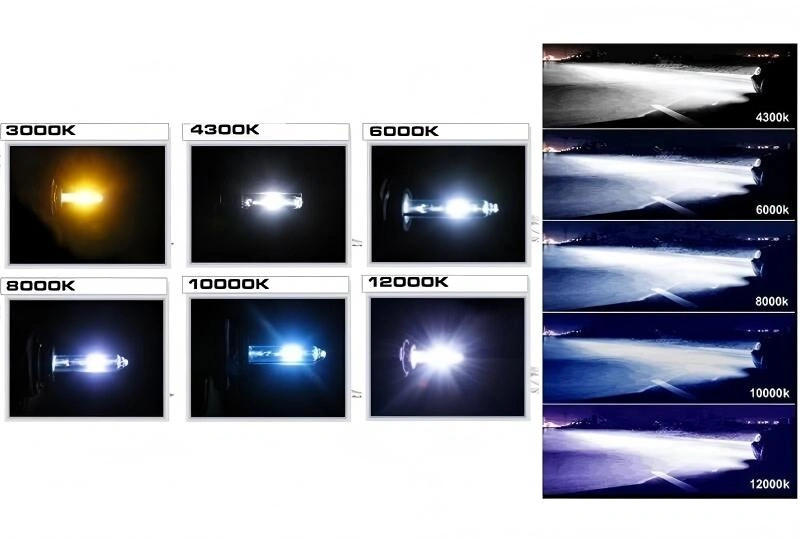
1.8 HID Color Temperature
The 4200K standard HID bulb has been on the market for years. While still popular, newer high-brightness versions with multiple color temperatures are impressive.
Based on specs alone, OSRAM CBI and Philips XV are excellent performers, with OSRAM Night Breaker and Philips WHV+ as strong competitors. Philips XV+ is currently a top-tier HID bulb.
Brightness and color temperature are both key when choosing bulbs. Philips and OSRAM use a unique strategy: instead of direct competition, they stagger their products to give customers different choices.
For example, when Philips XV was 4800K, OSRAM sold CBI at 6200K. Now, Philips promotes 5000K WHV+ (+120%), while OSRAM focuses on 4400K XNB (+220%) with 45W ballasts—offering distinct solutions in brightness, color, and price.
1.9 HID Ballast
What is HID Ballast?
The ballast is an essential component of an HID lighting system. Its function is to instantly boost the vehicle’s 12V voltage to a high voltage of 23,000V, using this intense voltage to ignite the xenon bulb and produce a strong light between the electrodes, achieving high-brightness illumination.
Types of HID Ballast
By Ballast Technology And Electronics:
Magnetic Ballasts – stable, robust but less efficient.
Electronic Ballasts – More efficient, better control, but usually more expensive.
Digital Ballasts – Advanced technology providing precise control, high efficiency.
By Ignition Method:
Probe Start Ballasts – Slower start-up and slightly less efficient.
Pulse Start Ballasts – Faster start, higher efficiency, more stable light output.
By Automotive Application:
Standard Ballast – Converts 12V to high voltage for xenon lights. Basic function.
Fast-Start Ballast – Starts faster than standard (≈1 second).
Canbus-Compatible Ballast – Solves errors when xenon lights are installed on vehicles with computer-monitored circuits.
Integrated Ballast – Vehicle-specific design for easy, safe, and stable installation.
Key Factors To Choose a Reliable HID Ballast
- Compatibilidad: Make sure the ballast is compatible with your lamp type, such as Metal Halide, 2. High-Pressure Sodium, or Xenon/HID.
- Wattage Match:The ballast wattage should match the lamp’s wattage to ensure proper performance and longevity.
- Choose from a reliable brands:Philips, Osram, and Hella are reliable choices for ballasts.
HELLA VS. OSRAM HID BALLAST
Osram’s new ballasts may look like used parts, but that’s because they undergo a series of tests before leaving the factory. One of these is a salt-spray test that lasts over 200 hours. After such exposure, it’s normal for the surface of most materials to show rust. This has no impact on the ballast’s performance, so manufacturers ship them as they are. The appearance may not look perfect, but the quality is absolutely solid.
Some people may still think that the Hella ballast is a fast-start ballast, but in fact, the startup speed of a D1S xenon lamp is mainly determined by the circuit design of the xenon bulb itself, not the ballast. All D1S ballasts only provide driving control and stable power output. The high-voltage ignition circuit is actually built inside the rear housing of the xenon bulb.
2.0 How To Install HID Headlight Bulb
1. Turn off the car & open the hood.
Let the headlights cool.
2. Remove the dust cover and unplug the old bulb.
3. Take out the old HID bulb.
4. Install the new bulb
(Do not touch the glass; lock it in place.)
5. Reconnect the wires, close the cover, and test the lights.
For a complete guide on HID installation and common troubleshooting tips, check out this HID kit installation guide.
Halogen and HID replacements keep things familiar, but they also come with limits—
higher power consumption, shorter lifespan, and weaker brightness compared to modern solutions.
That’s why more drivers are now upgrading directly from halogen to LED headlights. Read our part 2 to learn about LED headlight bulb upgrade.
Compartir esta entrada
NAOEVO es un fabricante profesional líder especializado en I+D, producción y venta de luces LED para automóviles, que ofrece soluciones integrales en el campo de la iluminación para automóviles.
NAOEVO es un fabricante profesional líder especializado en I+D, producción y venta de luces LED para automóviles, que ofrece soluciones integrales en el campo de la iluminación para automóviles. Únase a nuestra red mundial de socios.
Productos
2006-2025 NAOEVO Lighting - Todos los derechos reservados.
Hola, Bienvenido a NAOEVO.
La franja horaria del servicio manual de atención al cliente en tiempo real es Lun.-Vie. 09:00~18:00 (UTC+8).
Por favor, deje su pregunta aquí y será atendida con prontitud al siguiente día laborable.
¿Cómo podemos ayudar a su empresa hoy?